
Sunscreen for Women Who Hate the Feel of Sunscreen
You already know. You’ve read the dermatologist quotes, seen the side-by-side photographs, nodded along to the friend who swears it’s the only product that genuinely matters. Sunscreen is the one — the non-negotiable, the single most effective thing you can do for your skin.
And yet there it sits, somewhere in the back of the bathroom cabinet. Bought with good intentions. Used faithfully for a week. Quietly abandoned by the second.
Here is what almost no one says plainly: that isn’t laziness. It’s taste. For most of its history, daily sunscreen has been genuinely unpleasant to wear — and a woman with standards was entirely right to resist a product that left her face looking gray, feeling greasy, and smelling faintly of a holiday she wasn’t actually on.
The good news — and it is real, specific good news — is that the problem was never sunscreen. It was the sunscreen you were handed. The category has quietly transformed over the last few years, and the version that exists now bears very little resemblance to the one you remember.
This is the edit for the woman who hates the feel of sunscreen. Not another lecture. A way back in.
Why you stopped wearing it — and why you were right to
Let’s name the real objections, because not one of them was unreasonable.
There was the gray cast — the chalky, faintly ashen veil that made you look not protected but unwell. There was the film: that greasy layer that sat on top of the skin and refused to sink in, leaving your face shiny by mid-morning. There was the pilling, where the sunscreen rolled into tiny beads under your makeup, or your makeup simply slid off it by noon. There was the sting, the slow migration into the corners of your eyes over the course of an afternoon. There was the smell — that unmistakable scent, forever associated with a beach towel and never with a Tuesday at your desk. And underneath all of it, there was the simple, constant awareness of wearing something.
If any of these is the reason your sunscreen goes untouched, you do not have a willpower problem. You have a formula problem. And unlike willpower, formula problems are entirely solvable.
What actually changed
The sunscreen sitting in a beach bag a decade ago and the sunscreen worth buying today are barely the same product. Lighter textures — driven largely by Korean and French formulators, who treat sunscreen as a daily skincare step rather than a beach necessity — have reshaped the entire category. Newer ultraviolet filters protect more effectively while feeling like almost nothing. The thick, occlusive cream has been joined by an entire generation of fluids, essences, and serums built around a single goal: to disappear.
So if you tried sunscreen, hated it, and concluded the whole thing wasn’t for you — that conclusion was reasonable at the time, and it is now out of date.
The editorial edit: what to actually look for
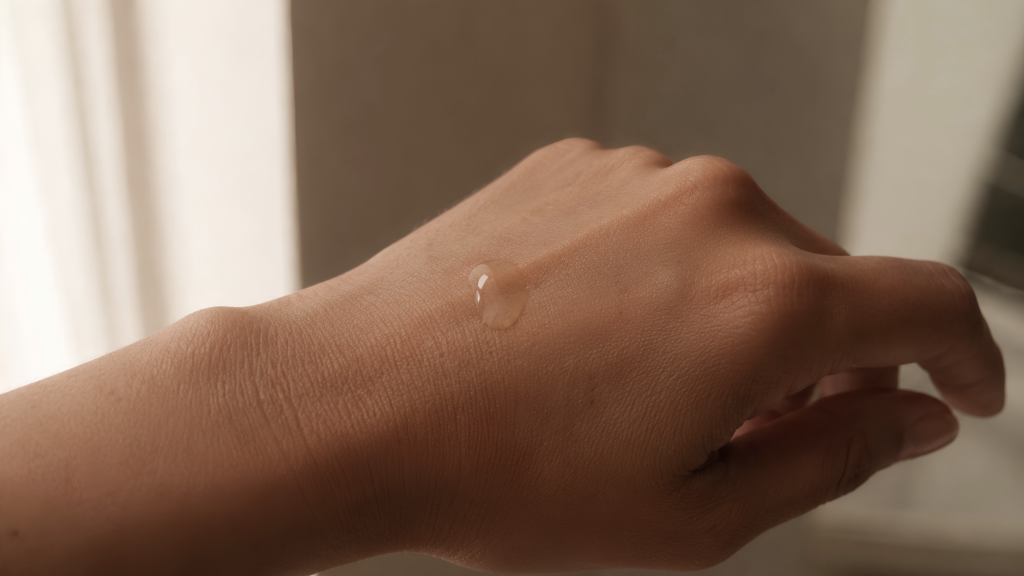
You don’t need to memorize ingredient science. You need to know which words on a label predict a sunscreen you’ll actually wear. Here is the edit, organized by the complaint each choice solves.
For the greasy film, look for texture words. Fluid. Essence. Serum. Milk. Watery. These aren’t marketing flourishes — they describe a category of sunscreen engineered to absorb the way a good serum does, leaving skin that feels like skin. If the word on the label sounds heavy, the texture usually is. If it sounds light, it usually is.
For shine or tightness, choose your finish deliberately — by your skin, not by trend. A dewy or glow finish flatters dry, normal, or mature skin; it reads as luminous rather than slick. A matte or dry-touch finish suits oily and combination skin, controlling shine without the powdery deadness of older formulas. Choosing the wrong finish for your skin is the most common reason a perfectly good sunscreen feels wrong.
For the gray cast, understand the one real choice. That ashen veil is almost always a mineral-filter issue — zinc oxide and titanium dioxide, which historically sat visibly on the skin. You have two genuine ways around it. The first is a modern, well-formulated mineral sunscreen; newer versions grind the minerals far finer and cast far less. The second is a chemical-filter sunscreen, which leaves no cast at all. The honest tradeoff: chemical filters feel weightless and invisible, but a small number of women find them irritating near the eyes; mineral filters are gentler for sensitive or reactive skin, but more prone to cast. Neither is morally superior, whatever the internet implies. Choose for the skin you actually have.
For the woman who has ten minutes, look for double duty. The best sunscreen is sometimes the one that lets you skip a different step. A sunscreen that doubles as a primer, a moisturizer with genuine broad-spectrum protection built in, or a treatment that protects while it does something else — each of these removes a step rather than adding one. For a morning measured in minutes, that math matters.
For the gray cast and a more awake face at once, consider a tint. A tinted sunscreen solves the cast problem by definition — there is no white to leave behind — while quietly evening out your skin tone. For many women, this is the conversion product: the one that finally makes daily SPF feel like an upgrade to how they look, rather than a chore subtracted from their morning. It often replaces light foundation entirely, which is one fewer thing on the shelf and one fewer step before the door.
Lightweight Sunscreens Worth Considering
This is not a “one best sunscreen for everyone” list. Skin is personal. These are examples of popular sunscreen types that may suit different problems.
For women who want an invisible, primer-like feel
Supergoop! Unseen Sunscreen SPF 50
This is a good style of sunscreen for women who hate white cast and want something that feels more like a makeup primer. Supergoop describes its Unseen Sunscreen SPF 50 as invisible, lightweight, quick-absorbing, and suitable for all skin types including acne-prone skin.
Best for: makeup users, white-cast haters, women who want a smooth primer-like finish.
Be careful if: you dislike silicone-like textures. Primer-style sunscreens can feel silky, but not everyone loves that slip.
For fast-absorbing daily face protection
La Roche-Posay Anthelios Ultra Light Fluid Facial Sunscreen SPF 60
This is a strong option for women who want something light, non-whitening, and makeup-friendly. La Roche-Posay describes it as broad-spectrum SPF 60, fast-absorbing, non-whitening, suitable as a smooth base for makeup, and water-resistant for 80 minutes.
Best for: daily face protection, makeup users, women who want a fluid texture.
Be careful if: your skin is very dry. Ultra-light fluids may need a hydrating moisturizer underneath.
For oily, acne-prone, or sensitive skin
EltaMD UV Clear Broad-Spectrum SPF 46
This is often discussed for acne-prone or sensitive skin because it is lightweight and oil-free. EltaMD states that UV Clear SPF 46 is designed for acne-prone, combination, and oily skin, and includes 5% niacinamide to help reduce the appearance of blemishes and discoloration.
Best for: oily skin, acne-prone skin, sensitive skin, redness-prone skin.
Be careful if: your skin does not like niacinamide. Many people tolerate it well, but not everyone.
For women who want a soft, hydrating K-beauty feel
Beauty of Joseon Relief Sun: Rice + Probiotics SPF50+ PA++++
This is the kind of sunscreen that appeals to women who want SPF to feel more like skincare. Beauty of Joseon describes it as creamy-yet-lightweight, hydrating, non-sticky, and dewy.
Best for: normal to dry skin, women who like a soft glow, minimal makeup days.
Be careful if: you strongly prefer a matte finish. This one is more comfortable and dewy than oil-control focused.
6. For women who want moisturizer and SPF in one step
CeraVe AM Facial Moisturizing Lotion SPF 30
This can suit a busy morning routine because it combines moisturizer and sunscreen in one product. CeraVe describes it as lightweight, oil-free, non-comedogenic, and formulated to help maintain the skin barrier.
Best for: simple routines, normal to dry skin, women who want fewer steps.
Be careful if: you are spending a long time outdoors. For outdoor days, you may prefer a dedicated water-resistant sunscreen.
For women who want no white cast and a matte finish
Black Girl Sunscreen Make It Matte SPF 45
This is a helpful option for women who struggle with white residue or shine. Black Girl Sunscreen describes Make It Matte SPF 45 as a lightweight gel sunscreen with a matte finish, no white residue, and broad-spectrum protection.
Best for: oily skin, deeper skin tones, women who hate white cast.
Be careful if: your skin is very dry. Matte formulas may need a hydrating layer underneath.
How to actually wear it
Two practical things, and then you’re done.
First, the amount. Most women apply far too little — and under-applied sunscreen does not deliver the protection on the label. The reliable measure is roughly two fingers’ length of product for the face and neck together. It sounds like a lot. It is the correct amount.
Second, the placement. Sunscreen is the final step of skincare and the step before makeup — moisturizer first, sunscreen next, makeup last. Give it a minute, genuinely sixty seconds, to settle before anything goes on top. That single pause is the difference between makeup that sits beautifully and makeup that pills. Done properly, the whole thing costs you about ten seconds of actual effort.
The honest part: reapplication

Here is where most articles quietly lie to you, so this one won’t.
The advice says to reapply every two hours. Almost no working woman with a full day does this, and pretending otherwise helps no one. So let’s be realistic instead. A generous, correct morning application — and nothing more — is still vastly better than a bare face. If your day is spent mostly indoors, moving between a car and an office, your morning sunscreen is doing real and meaningful work.
If you genuinely are outside at midday — a long lunch, a school sports afternoon, a weekend in the park — reapplication does matter, and you obviously can’t re-cream over makeup. The tools that exist for exactly this are an SPF powder, an SPF stick, or an SPF mist. None is as protective as a proper morning application. All are better than nothing at one o’clock.
The editorial stance Femuty will take, plainly: do the morning step well, every single day, and you have done the thing that matters most. Do not let an unattainable reapplication routine talk you out of the achievable one. Consistency in the morning beats perfection you’ll never keep.
The bottom line
Of every step in a skincare routine, this is the one with the most visible and most lasting return. It is, quite literally, the step that decides how your skin looks in your forties — the slow, invisible work of preventing what you’d otherwise spend a fortune trying to correct later. (We go deeper into that shift in [What Changes in Your Skin at 35 — and the Quiet Luxury Routine That Actually Helps].) And it asks for ten seconds of your morning.
You were never the kind of woman who couldn’t be bothered to take care of herself. You were the kind of woman who refused to wear something that felt bad on her skin. That standard was always correct. It simply needed a better product to live up to it — and now, finally, there is one.