
The Soft Life Era After 40: How to Slow Down on Purpose
The soft life era, in brief
- The soft life is a deliberate choice to live at a slower, gentler pace — peace and rest over hustle and constant productivity.
- For women over 40, it usually means stepping out of decades of striving to build a life that feels good rather than merely looks accomplished.
- It isn’t laziness and it isn’t quitting your responsibilities — it’s changing your relationship to them.
- You build it in the margins: slower mornings, softer reactions, protected boundaries, quiet beauty at home.
- Softness is partly a privilege and always a practice — available in small portions to almost anyone, almost anywhere.
There’s a phrase quietly circling the corners of the internet, and it has settled into the vocabulary of women who are tired in a way that sleep doesn’t fix. The soft life era. On the surface it sounds like an aesthetic — linen, slow mornings, a cup of tea catching the light. Underneath, it’s something more deliberate: a decision to stop measuring your worth by how much you produce.
For women who came of age inside the cult of the girl boss, this is not a small shift. We were handed a script that said ambition was the highest virtue, that rest had to be earned, that a full calendar was proof of a life well spent. Many of us followed it faithfully — through careers, through raising children, through holding households and aging parents and everyone else’s needs in our two hands. And somewhere in our forties, a quieter question begins to surface: Was all that hurry ever the point?
The soft life is the considered answer. Not a retreat from responsibility, and certainly not laziness dressed up in nice lighting, but a turning-down of the volume — a choice to move through your days with more grace and less grip. This is a guide to stepping into that softer pace, written for the woman who has already proven everything she needed to prove, and is ready to stop proving.
What is the soft life era?
The soft life era is a deliberate choice to live at a slower, gentler pace — prioritising peace, rest, and emotional ease over hustle and constant productivity. For women over 40, it often means stepping out of decades of striving to build a life that feels good rather than merely looks accomplished. It is not about having less to do, but about changing your relationship to all of it.
Let’s clear away a misunderstanding straight away. The soft life is not about a lighter to-do list; for most women in midlife, the list does not politely shorten itself. It means choosing peace over pressure where you have the choice. It means releasing the compulsion to optimise every hour. It means letting “enough” be a place you can actually arrive at, rather than a horizon that keeps receding the closer you get.
There’s a particular freedom that becomes available in your forties and fifties — the freedom of no longer needing to be impressive. You’ve been competent. You’ve been reliable. You’ve carried what needed carrying. The soft life is what you build on the other side of all that effort: a life that is allowed to feel good rather than merely look accomplished.
And a note of honesty, because empty encouragement helps no one: softness is, in part, a privilege. Not everyone can simply slow their pace; bills don’t soften, and obligations rarely ask permission. But softness is also a practice, available in small portions to almost anyone, almost anywhere. You build it in the margins — five quiet minutes, one protected boundary, a single unhurried cup of coffee — until the margins begin to widen.
How to step into your soft life era: 10 gentle practices
1. Let slowness become a decision, not an accident
Slowing down on purpose is the first practice of the soft life. Most of us don’t choose our pace; we inherit it from circumstance and then mistake it for our personality. The move toward a softer life begins in the small moments where the speed was never actually necessary.
The traffic is not moving faster because you are tense about it. The kettle does not boil sooner because you are hovering. So much of our rushing is a habit the body holds long after the emergency has passed — a low hum of urgency that has simply forgotten how to switch off.
Begin where it costs you nothing. Drink your morning coffee sitting down. Walk to the car at the pace of someone who is not late. Give yourself a ten-minute buffer before appointments so you arrive composed instead of breathless. These are tiny corrections, but they teach the nervous system something it may not have felt in years: there is no emergency here. The anxiety many of us carry is less a personality trait than the residue of a life lived permanently in fast-forward. Slow the pace, and you may be surprised how much of that weight quietly lifts.
2. Step off the productivity treadmill
Stepping off the productivity treadmill means letting some hours exist without an output to justify them. We were taught — by hustle culture, by every productivity guru with a morning routine to sell — that a worthwhile life is a maximised one, our hours scheduled, measured, and justified by what they produce. We took our cues from people running themselves into burnout, and then wondered why our own well-ordered lives felt so strangely hollow.
But a life is not a spreadsheet, and not everything worth doing produces a result you can point to. The afternoon spent cooking something slow. The phone call with an old friend that solves nothing and restores everything. The hour with a book that earns you nothing but a quieter mind. When we sort our days into “productive” and “wasteful,” we quietly rob ourselves of the ordinary pleasures that actually make a life feel full.
The soft life works when work is needed and rests when it isn’t — and, crucially, it does not apologise for the resting. It celebrates the quiet victories alongside the loud ones: presence, peace, good relationships, the simple competence of a day well lived. You are enough whether or not you achieved anything measurable today. For women who have spent decades earning their worth in output, that sentence can take a long time to believe. Read it again anyway.
3. Soften your reactions
Softening your reactions is where much of the soft life is actually won or lost. The heaviness we carry often comes not from what happens to us, but from how fiercely we meet it — and a soft life begins, in a real sense, in the half-second between a thing happening and our response to it.
Notice yourself across an ordinary day. How do you react when plans collapse? When someone disappoints you? When the world declines to arrange itself the way you’d hoped? Most situations are remarkably neutral until our reaction gives them weight — it’s the response that decides whether a moment becomes a heavy one or simply passes through.
Softening your reactions does not mean ignoring what genuinely hurts, or performing a serenity you don’t feel. It means building a small pause where there used to be a reflex. You won’t manage it every time, and that’s fine — you are not your first flash of irritation, you are the awareness that arrives a breath later. The question worth keeping close is simply: Is there a gentler way to meet this? More often than we expect, there is.
4. Make gracefulness a way of moving
Gracefulness, in the soft life, is less about posture than about how you move through the world. Grace is usually pictured as something physical — poise, elegant carriage. But the deeper kind is an internal quality.
To live gracefully is to do ordinary things with a little more care and a little less force. To close a drawer gently. To speak without sharpening the edges of your words. To extend the same patience to a fumbling stranger that you’d hope to receive on your own worst morning. And, perhaps hardest of all, to offer that grace inward — to meet your own mistakes without the harsh internal commentary so many of us run on a loop.
Gracefulness is not perfection or politeness for show. It’s a gentleness of manner that, practised daily, slowly changes the texture of an entire life.
5. Treat self-care as maintenance, not indulgence
Self-care in the soft life is maintenance, not indulgence. Everything that functions requires upkeep. We service the car, we maintain the home, we keep the things we value in good repair. Yet somewhere along the way, many women quietly remove themselves from the list of things worth maintaining — until illness or burnout forces the correction.
This is worth saying plainly, because midlife is precisely when the consequences of neglect begin to make themselves known: caring for yourself is not an indulgence. It is the maintenance of the one body and the one life you are given. Softness begins with how you tend to yourself when no one is keeping score.
What that tending looks like is personal, and it needn’t be elaborate or expensive. Nourishing the skin that has carried you this far. Moving your body in ways that feel like care rather than punishment. Protecting your sleep as though it mattered, because it does — more, in midlife, than almost anything else. Keeping a small corner of the week for something that exists purely because it brings you joy. The underlying message you send yourself with each of these is the one that matters most: I am worth tending to.
6. Dress for the woman you actually are
Dressing for the woman you are now is one of the soft life’s quiet pleasures. How you dress shapes how you feel from the inside out, and this only becomes truer with age. Clothing is not vanity; it’s a daily, wordless conversation you have with yourself about how much you matter.
The soft life leans naturally toward a quieter elegance — fewer pieces, better ones; fabrics that feel good against the skin; clothes that fit the body you have today rather than punishing it for not being the body you had at thirty. A well-cut coat. A sweater in a colour that flatters you now. The pleasure of getting dressed for yourself rather than for anyone’s approval.
And this extends past the front door — in fact, it’s most important behind it. So much of midlife is lived at home, in the hours no one else sees, and those hours deserve more than whatever happened to be within reach. Soft loungewear, a robe that feels like a small luxury, sleepwear chosen with the same care you’d give an outfit for the world. You are the person who spends the most time in your own company. There is quiet dignity in dressing well for her.
7. Surround yourself with quiet beauty
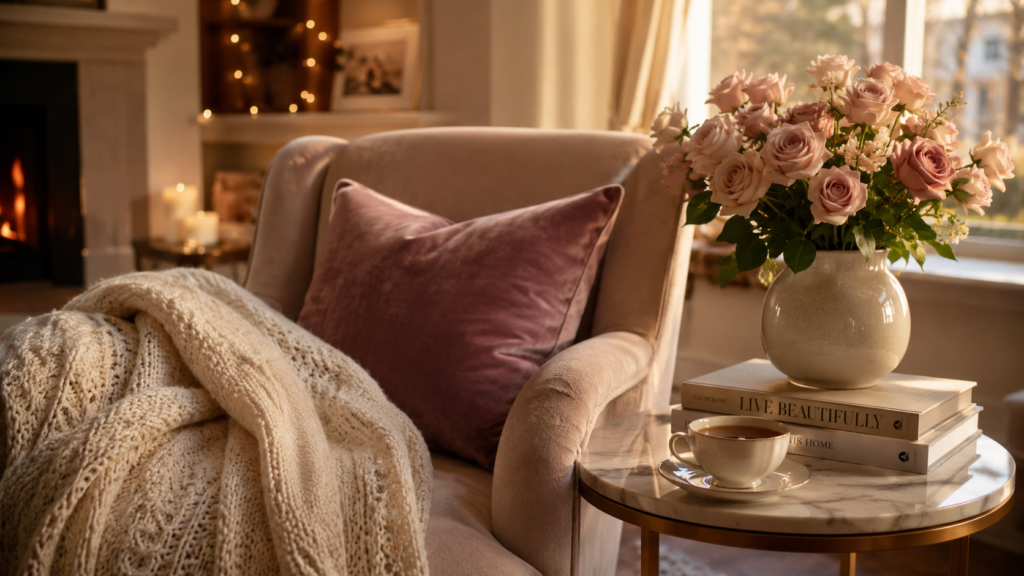
Surrounding yourself with quiet beauty is how the soft life becomes visible in your daily surroundings. You don’t need a renovated home or a designer’s budget. Quiet luxury was never really about money; it’s about attention — the small, deliberate touches that make ordinary surroundings feel cared for.
A single vase with fresh flowers on the kitchen counter. The good cup, used on a Tuesday, instead of saved for a special occasion that never quite comes. Bed linen that makes rest feel like an event. A clear surface where there used to be clutter. A candle lit not for guests but simply because the evening deserved it. Light, texture, a little order, a little fragrance — these are not extravagances. When your surroundings reflect calm, your inner life tends to follow.
8. Stay honest with your emotions
Emotional honesty is the soft life’s quiet form of strength. A soft woman doesn’t mistake stoicism for it. She doesn’t tuck her feelings away and call it coping. Instead, she lets them move through her — naming them, feeling them, and trusting that none of them is permanent.
Think of your emotions as guests passing through. The grief, the joy, the irritation, the tenderness — they arrive, they stay a while, and they go. They are not the architecture of who you are; they are weather moving across it. The work is simply to let them pass without either clinging to them or pretending they never came.
This matters especially in midlife, a season that arrives with real change — in the body, in relationships, in the shape of a life that is visibly shifting. There is more, not less, to feel during these years. Softness here means giving yourself permission to feel all of it honestly, without shame and without rushing to be fine. Emotional honesty is not weakness. It is one of the quietest forms of strength there is.
9. Protect your peace without apology
Protecting your peace without apology may be the soft life’s hardest practice and its most necessary. Here is a truth that takes many women decades to fully accept: not everyone is entitled to your time, your energy, or your softness. Peace is not a luxury you’ll get around to once everyone else is satisfied. It is something you are allowed to guard now.
This means boundaries — the real kind, the ones that occasionally disappoint people. It means stepping back from the relationships and obligations that drain you faster than they fill you. Anything that routinely costs you your sleep or your serenity is simply too expensive, no matter how long you’ve been paying for it.
By your forties, you have likely earned a sharper instinct for what is worth your energy and what is quietly bleeding it away. Trust that instinct. Protecting your peace is not selfishness; it is the basic maintenance that makes a soft life possible at all.
10. Let gratitude do its quiet work
Gratitude is the practice that ties the soft life together. A grateful heart is, almost by definition, a soft one. When you can still be moved by small things — the warmth of a morning, an unexpected kindness, the simple relief of arriving home safely — it means the years haven’t managed to harden you, and that is no small achievement.
Gratitude isn’t about pretending everything is wonderful. It’s a discipline of attention: choosing to notice what is already good in a life, especially on the days that feel ordinary or hard. Like any practice, it strengthens with repetition until it becomes second nature — the way complaint, for many of us, became second nature long ago without our ever deciding it should.
A simple beginning: each night, name three good things from your day. Write them, say them, or simply hold them in mind before sleep. It seems almost too small to matter. Done consistently, it slowly retrains the eye to find the softness that was there all along.
A softer way forward

The soft life era is not a destination you reach and then stay in. It’s a series of small choices, made and remade, on good days and difficult ones alike. It asks only that you stop treating your own ease as the last item on a list you never finish.
For the woman in midlife, this is less a reinvention than a homecoming. The grace was always in you; the years simply buried it under everything you had to carry. Setting some of that weight down — slowing the pace, softening the reactions, protecting the peace, noticing the beauty — is how you find it again.
You have spent a long time being strong for everyone else. The soft life is what happens when you finally let yourself be gentle with you.
You might also like:
- Understanding perimenopause: a calm, practical guide
- A gentle skincare routine for women over 40
- How to build a slow, unhurried morning
- Building a quiet-luxury capsule wardrobe
Frequently asked questions about the soft life
What does the “soft life era” mean?
The soft life means choosing a slower, gentler, more peaceful way of living — prioritising rest, ease, and emotional wellbeing over hustle and constant achievement. It’s less an aesthetic than a mindset: a decision to stop measuring your worth by how much you produce.
Is the soft life just being lazy?
No. Laziness is the avoidance of effort; the soft life is the intentional redirection of it. You still meet your responsibilities — you simply stop treating busyness as proof of worth, and you make deliberate room for rest, presence, and peace alongside the work.
How do I start living a soft life with a busy schedule?
Begin in the margins. Slow down in the small moments where speed was never necessary, protect one boundary that guards your peace, and add a single unhurried ritual to your day. The soft life is built from tiny, repeatable choices, not a dramatic overhaul of your circumstances.
Is the soft life realistic for women over 40 with real responsibilities?
Yes, though honestly. Slowing your pace is partly a privilege, and not every obligation can be set down. But softness is also a practice available in small portions to almost anyone — and midlife, with its hard-won clarity about what actually matters, is often the ideal time to begin.
What’s the difference between the soft life and quiet luxury?
Quiet luxury is largely about aesthetics — understated elegance, fine materials, restraint over display. The soft life is about how you live and feel: peace, slowness, emotional ease. They overlap beautifully (both value calm and intention), but one describes a style and the other describes a way of being.